


Tonari Gumi Newsletter November 2026

Table of Contents
Trip to the Japanese Canadian Memorial Dedication in Victoria
Program Registration Opens November 30
Thank You for Joining Us at our Fall Bazaar!
Staff Introduction: Beth Miyanaga
Oak Tree Club Celebrates Halloween at VJLS-JH
September Seniors Workshop Series: What are the "Concerns" and "Hopes" you wish to realize?
✨ November Outing: Lights at Lafarge & Korean Dinner
New Class Announcement: Handbell!
Please Join us for our Christmas Party!
Let’s Celebrate the New Year Together!
A Message from the Japanese Canadian Legacies Society
Japanese Canadian Monument Opening
BC Heritage Sites November Openings: Surrey & Victoria

Trip to the Japanese Canadian Memorial Dedication in Victoria
Saturday, October 3, 2026 was a memorable day for Tonari Gumi and for the Japanese Canadian community throughout Canada. On that day, 52 participants boarded a bus chartered by Tonari Gumi early in the morning to attend the dedication of the Japanese Canadian Memorial in Victoria, B.C. Together with similar buses from the Steveston Buddhist Temple and the Steveston Japanese Canadian Community, we made it to the Tsawwassen ferry terminal to catch the 9:00 am ferry to Swartz Bay and on to Victoria. Many of the passengers on our bus were survivors of the internment, ranging in age from late 70’s to early 90’s.
While everyone was excited to be going to this event, no one was exactly sure what to expect. As we pulled into the area near the provincial legislature buildings, we were pleasantly surprised to be greeted by cheerful volunteers wearing blue Victoria Nikkei Cultural Society happi coats. On departing from the bus, Masako and the TG volunteers handed us our bento lunches. Our first order of business was to find a seat where we could enjoy the lunches, prepared by TG’s chef Endo and packed by Masako extremely early that morning. At the monument site, we were impressed by the abundance of seating and helpful volunteers.
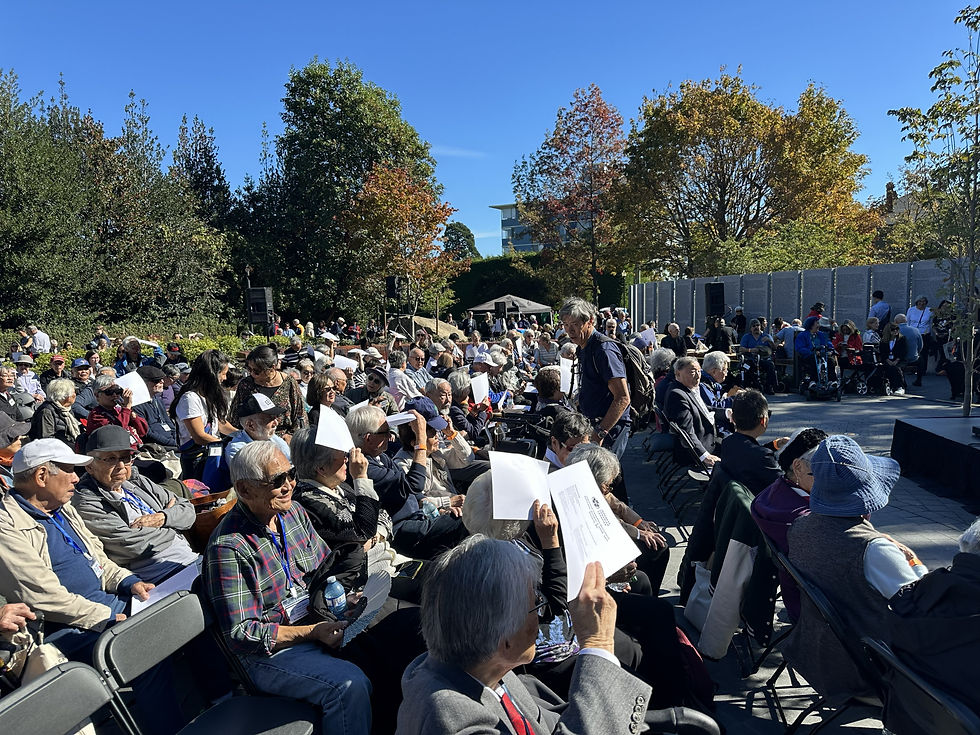
We could see spread out in undulating curves in front of us, 100 engraved granite panels. The names of some 22,000 Japanese Canadians, who had been forcibly uprooted and had their lives changed forever in 1942, were permanently etched. Some 3,000 other names of their children, who had been born before the discriminatory restrictions were lifted on April 1, 1949, were also engraved into panels. We began to see more groups of Japanese Canadians arriving from other parts of Canada, such as: Edmonton, Calgary, Lethbridge, Manitoba and Toronto. The event, rather than being somber, was joyous. Many participants said that being able to meet friends and family that they had not seen for a long time, in some cases for decades, was one of the best parts of the event.

As soon as possible, we all fanned out to find names – our own, and those of our families and people we knew who had been affected. It was awe-inspiring to see how many names there were engraved into each panel. The line of 100 panels stretches for some 300 feet. Each half-ton panel is 4 inches thick, 6 feet 7 inches tall and 36 inches wide. Each panel is separate, and the small space between allows light to come through. While being struck by how large it was, the curves and spaces allowed for some intimate “coves” formed in the wall. I found my mother’s name on the panel for Langley and my own name on a panel for those born after the uprooting. One of our TG participants said, “I was immediately struck by how many names there were. We think about how the internment affected us and our families, but seeing the monument, I understood and felt for the first time how many individuals were affected. This was a bigger thing than I had realized. So many lives were changed, so many people would never recover what they had lost.” Another saw it completely differently, “When I saw my name engraved in the stone, it struck me that I was remembered. Among all the other names, I was there and what had happened to me would not be forgotten”.


Interspersed along the walkway were little mounds or islands with large, engraved stones. Chiseled into the stones were key words which described the different aspects of the uprootings (not just once, but two or three times for different families): “tabidachi”, new journeys in life; “kizuna”, building bonds of community; “uragiri”, betrayals on the part of the governments as promises were broken; “gaman”, perseverance as families and individuals endured and moved on; and “kintsugi”, making anew what has been broken. This was the pathway taken by Japanese Canadians as they made their way to receiving justice. The program was moving as we heard from the architect, Bruce Kuwabara; from Paul Kariya, President of the JC Legacies Society; from Susanne Tabata, CEO of the Society; Haiqa Cheema, Assistant Deputy Minister, Government of BC, and Yoshiaki Takahashi, Consul General of Japan. Particularly touching was Mary Kitagawa’s comments, representing the survivors, as she and her family had lived and experienced the pain and suffering, but also survived and worked to rebuild the community that had been broken. A special round of applause honoured Susanne Tabata and how her hard work and perseverance had ensured that the BC redress happened.

In general, everyone who participated was pleased with what had taken place, the planning, the organization and the implementation. Was it worth all the money that had been expended? There were mixed feelings. Most felt that it was good to see something more “permanent” created because of the provincial redress—something that their children and grandchildren could see and learn from. Some expressed concern that the monument might not last if it was not properly maintained. They worried about the possibility of more broken promises, as the BC government has agreed to maintain the gardens and the monument. Some felt that more people would have been able to visit the monument had it been erected in Vancouver.

However, all in all, nearly everyone liked what they saw; and the event and the great effort made to get us all there was appreciated. Tonari Gumi’s extra efforts to organize this bus trip were particularly noted. This was one more step on the pathway and it is incumbent on all of us to share our feelings and stories with our posterity. When visiting the new monument, there will always be that moment of awe upon seeing all those names and all those places from where individuals and families were uprooted, to see the name of a family member etched in stone. Just as those in power needed to take responsibility, we have the responsibility to ensure that the lessons are passed on and preserved, so this tragedy is not repeated.
Author: David Iwaasa
Program Registration Opens November 30
Friendly Reminder: Registration for January–March programs begins on November 30 at 10:00 a.m. Don’t forget to register!
Our Winter 2027 programs will start on Monday, January 4th.

Connecting Through Bon Odori - National Seniors Day 2026
On Thursday, October 1, the National Seniors Day 2026 Show and Dance Party at Brock House concluded successfully, thanks to everyone’s support. Performances, music and dancing brought seniors together for a wonderful afternoon of celebration and connection.
The event was organized collaboratively by the Alliance of Seniors’ Centres (ASC), a network of five seniors-serving organizations in Vancouver: 411 Seniors Centre Society, Brock House Society, South Granville Seniors Centre, West End Seniors’ Network and Japanese Community Volunteers Association (Tonari Gumi). By sharing knowledge, resources and experience, these organizations help older adults stay healthy, connected and actively involved in their communities.

Tonari Gumi’s Men’s Club practised for six weeks to prepare their performance of “Tanko Bushi,” a traditional Japanese bon odori dance. Dressed in wonderful outfits, the members proudly shared the results of their hard work, introducing seniors from other organizations to a cherished Japanese summer tradition.
The final dance session was another highlight, bringing everyone together for a joyful end to the afternoon. Our heartfelt thanks go to the Men’s Club members, everyone who attended and the staff and volunteers from all five organizations who helped prepare and run the event.
We look forward to continuing our work with our ASC partners to strengthen connections and expand the network of support for seniors across Vancouver.

Thank You for Joining Us at our Fall Bazaar!
Despite the rainy weather and the fact that our Fall Bazaar coincided with the BC provincial election and other local events, we were delighted to welcome so many visitors and bring the event to a successful close.
On the day of the bazaar, many people lined up before opening time, patiently waiting in the cold and rain for the doors to open. We are truly grateful for your enthusiasm and continued support.
Visitors enjoyed seasonal favourites prepared in the Tonari Gumi kitchen, including tonjiru (Japanese pork and vegetable soup) and karaage (Japanese fried chicken), as well as locally harvested matsutake mushrooms. We also received many generous donations of kimonos, Japanese tableware, books, and other items, which helped make this year's bazaar even more special.

Our heartfelt thanks go to everyone who donated items, all the volunteers who helped with preparations, event-day operations, cleanup and everyone who came to support us.
Thanks to your generosity, hard work and community spirit, we were able to host another wonderful Fall Bazaar. Thank you all for making it such a success!


★ VOLUNTEERS WANTED! ★
Tonari Gumi is looking for volunteers to support our daily activities and programs.
If you have some time to spare or are interested in any of the activities below, we would love to have you join us! First-time volunteers are always welcome.
🌸 Regular Volunteer Opportunities
★ Mondays: Kitchen Prep
Lunch and Bento Preparation & Cleanup
Help us prepare lunches for Meals on Wheels and other programs. Duties include washing dishes using the dishwasher and cleaning up the kitchen. You can also enjoy planning menus together and learning about Japanese cooking, including how to make dashi (Japanese soup stock) and other basic cooking techniques.
8:30 or 9:00 AM–12:00 PM
12:30–3:30 PM
★ Tuesdays: Kitchen Help
Lunch and Bento Preparation & Cleanup
8:30 or 9:00–11:30 AM
★ Thursdays: Kitchen Help
Help prepare meals and snacks for volunteers and keep the kitchen organized. Scheduling is flexible and can be arranged to suit your availability.
★ Fridays: TG Café Floor Support
Help welcome and socialize with TG Café participants, serve lunch, and assist with cleanup after the café.
9:30 AM–2:00 PM Finishing time may vary.
★ Fridays: TG Café Kitchen Help
Help with dishwashing using the dishwasher and kitchen cleanup after TG Café.
12:30–2:00 PM Finishing time may vary.
★ Local News Article Preparation
Help translate online news articles from English into Japanese and prepare them for reading aloud. Articles are distributed every Monday. Long-term volunteers are especially welcome.
★ iPad Group Class Support
Help support our iPad group classes.
Thursdays, 12:50–2:40 PM
★ Data Entry
Help support Tonari Gumi's activities by assisting with data entry.
One day or more per week, approximately 2–4 hours per shift
Long-term volunteers are especially welcome.
🧹 December Year-End Cleaning – Volunteers Wanted!
We are looking for volunteers to help with our annual year-end cleaning at Tonari Gumi.
Dates: December 8 (Tuesday)–11 (Friday), tentatively scheduled
Time: 10:00 AM–3:00 PM
You are welcome to help on any day that works for you. Every bit of help is greatly appreciated!
If you are interested in volunteering or would like more information, please contact Rie at Tonari Gumi.
Email: programs@tonarigumi.ca
We look forward to hearing from you and welcoming you to our volunteer team!
Staff Introduction: Beth Miyanaga
Hello! My name is Beth Miyanaga, and I am the new Program and Volunteer Assistant here at Tonari Gumi. I am a Yonsei (fourth generation) Japanese Canadian on my father’s side. Growing up I did not speak any Japanese but was always very curious about Japanese culture. I graduated from SFU in 2022 with a Bachelor of Arts in Sociology. After graduating, I wanted to do work that contributes to societal good, especially within my own community. This led me to work as an outreach worker for the Japanese Canadian Survivors Health and Wellness Fund Society, a position in which I was able to connect Japanese Canadian seniors who had been affected by the actions of the BC government in the 1940s with health and wellness grants. This was very meaningful work to me and allowed me to begin to make connections to people within the community. Last year, I also had the incredible opportunity to work at the Canada Pavilion at Expo 2025 in Osaka, Japan. This allowed me to share about Canada with visitors from all over the world, majority of whom were Japanese, thus also allowing me to practice my Japanese speaking skills. I am very excited to be working now at Tonari Gumi in a position that will continue to allow me to contribute to the Japanese Canadian community.

Community Services Updates
Oak Tree Club Celebrates Halloween at VJLS-JH
Under the beautiful autumn sunshine, and with the generous support of the Frank H. Hori Charitable Foundation, Oak Tree Club held its Halloween event at the Vancouver Japanese Language School and Japanese Hall (VJLS-JH).
Oak Tree Club is one of Tonari Gumi’s peer support groups. It holds monthly online meetings to provide support and connection for families and caregivers of children with neurodiversity.
More than 20 children participated in the event, enjoying a variety of activities in the school’s spacious gymnasium. Activity stations included pumpkin decorating, fall-themed colouring, and storytime led by Midoriko-san. Parents and volunteers helped make the activities fun and welcoming for everyone.
Oak Tree Club is planning an online workshop in 2027. For updates and more information, please visit the Tonari Gumi website:


September Seniors Workshop Series: What are the "Concerns" and "Hopes" you wish to realize?
Our three-part Senior Workshop Series began on September 15. During the first workshop, participants had an opportunity to talk openly at their own pace about concerns, challenges and things that have been on their minds in their daily lives. They shared their thoughts and experiences with one another in a warm and welcoming small group setting.
We were pleased to welcome Ms. Chifuyu Casaclang of SADE Counselling as the facilitator. With a small group, participants were able to listen to one another’s experiences and perspectives and enjoy meaningful conversations in a relaxed atmosphere.
The second workshop took place on October 20, with the final session on November 17.
Through this three-part series, we hope to provide a space where participants can talk openly with one another—not to face their “concerns” alone, but to explore together how they can discover and work toward their own hopes and wishes for the future.

✨ November Outing: Lights at Lafarge & Korean Dinner
Join us for a fun evening outing on Monday, November 30, 2026!
We’ll start with a delicious Korean dinner at OZ Korean Cuisine in Coquitlam followed by a visit to Lights at Lafarge, the beautiful seasonal light display around Lafarge Lake.
📅 Date: Monday, November 30, 2026
🍽️ Dinner: 5:00 PM at OZ Korean Cuisine
✨ Lights at Lafarge: Approximately 6:00–7:00 PM
Meeting Locations & Times
•Tonari Gumi: Meet at 3:30 PM; depart at 3:35 PM with Rie.
• Lincoln SkyTrain Station (Millennium Line / Evergreen Extension): Meet between 4:40 and 4:45 PM.
• OZ Korean Cuisine: Meet at the restaurant at 5:00 PM.
Participation Fee
Tonari Gumi members: $5
Non-members: $10
Please note: The participation fee does not include dinner. Participants are responsible for paying for their own meals.
Registration Deadline: Monday, November 23, 2026
📝 Register Here
Google Form: https://forms.gle/Z1TtGRgTdirzfk2Q9
Please dress warmly and wear comfortable walking shoes, as we will be walking outdoors.
We look forward to enjoying a delicious Korean dinner and the beautiful holiday lights with you!

New Class Announcement: Handbell!
We are excited to announce that we will be starting a handbell class on Tuesday, November 3rd. We are grateful to one of our volunteers for offering to lead the class. This class is a wonderful opportunity to enjoy playing handbells, explore music and connect with other members. We have received enthusiastic interest in this class and we hope to continue offering it during our upcoming Winter Term.

Tanoshii! Fude-Moji Art Class
Join us for a special Japanese Fude-moji Art Class with Eri-sensei, who also teaches our iPad classes!
Why not create your own handmade Christmas cards and Japanese New Year’s cards to send to your friends and family?
Date: Thursday, December 3
Time: 1:00–2:30 PM
Limited to the first 20 participants! Sign up early to reserve your spot!

Please Join us for our Christmas Party!
Celebrate the season with fellow Tonari Gumi members while enjoying lively entertainment, delicious food and opportunities to win prizes. It will be a warm and welcoming gathering filled with laughter, connection and holiday cheer.
Date: Monday, December 7, 2026
Time: 11:00 am to 1:00 pm
Location: Heritage Hall, 3102 Main Street, Vancouver
Please register by using the following form: https://forms.gle/yymFSU6MrUD68Roq7
Registration is open until Sunday, November 22.
You can also register by contacting Beth at office@tonarigumi.ca or 604-687-2172 (ext. 101).
Please note that this event is for Tonari Gumi Members only.

Let’s Celebrate the New Year Together!
Sunday, January 3, 2027, from 11:00 a.m. to 2:00 p.m
We hope to bring together as many members as possible to enjoy osechi (traditional Japanese New Year dishes), games and time with friends. Let’s begin a healthy and happy year by celebrating our connections and supporting one another.
Senior members who would like to volunteer are warmly welcome!
We would greatly appreciate help in the kitchen, at reception and with leading games. Even a little of your time would make a difference. Please help in whatever way feels comfortable for you.
If you are available to help, please contact Masako by email:
Masako ed@tonarigumi.ca 604-838-6340
Registration: November 16 (Monday) – December 10 (Thursday), 2026
Registration will close once we reach the capacity of 100 participants.
Please register using the link below.
Registration Link:
Please see the attached poster for event details. We look forward to celebrating with you!
In 2027, I hope our members, staff, and volunteers will continue working together to make Tonari Gumi a welcoming and enjoyable place for everyone.


Japanese Canadian Monument Opening
“In creating this Monument, we remember our ancestors not only as victims of state-sanctioned injustice, but as builders of this province.”
— Susanne Tabata, CEO, Japanese Canadian Legacies Society and Project Lead, Japanese Canadian Monument
Six years in the making, the new Japanese Canadian Monument in Victoria features a 300-foot-long undulating wall of 100 granite panels engraved with the names of 22,000 Japanese Canadians uprooted from their coastal homes in 1942—organized by where they lived at the time—alongside 3,000 children born during this period of rupture.
We extend our deepest gratitude to everyone who joined us on Saturday, October 3 in opening this place of remembrance and healing, whether in person in Victoria or online across the country. Thank you to the community organizations who hosted the 15 livestream viewing parties in Montreal, Toronto, Hamilton, Winnipeg, Lethbridge, Calgary, Edmonton, New Denver, Kamloops, Sunshine Valley (Tashme), Steveston, Burnaby, Ucluelet, and Nanaimo, including three seniors residences: Momiji Health Care, Wisteria Place, and Robert Nimi Nikkei Home.

We also thank the nearly 2,000 survivors, descendants, neighbours, and Victoria residents who attended the nine guided tours held October 4, 5, 6, and 7. Participants were introduced to the interpretive design, wall of names, landscape design, Pathway to Justice, and the companion website built in partnership with the University of Victoria.
Outside of the structured tours, many families spent time at the wall in discussion and contemplation, often taking rubbings of names with paper and pencil.
The creation of this Monument and the opening was truly a national endeavour and we thank everyone who put in the incredible effort needed to make it happen. We do this work in honour of our seniors, and to everyone who made sure that they were taken care of properly, domo arigato gozaimasu.

Monument Website
Because details of family lineage were often lost due to wartime displacement and the decades of silence that followed, the searchable database—available at JapaneseCanadianMonument.uvic.ca—allows families to locate ancestors on the wall, view pre-war map locations, and connect to names in historical case files.
Monument Site Temporary Closure
The Monument site is now closed to the public in order to complete construction and is expected to remain closed through November. We advise you to please not make any travel arrangements for now.
This temporary closure will allow remaining site work to continue safely. Thank you for your understanding. We will announce an opening date as soon as we are able.
Please email opening@jclegacies.com with questions.
For more information, visit jclegacies.com/japanese-canadian-monument/.
BC Heritage Sites November Openings: Surrey & Victoria
Following the October openings, the Japanese Canadian Legacies Society (JCLS) is pleased to share a series of heritage site openings taking place this November. Through the BC Heritage Sites and Legacy Community Projects programs, JCLS works with communities across British Columbia to preserve and share Japanese Canadian history.
Survivors, descendants, families, and everyone interested in learning more about Japanese Canadian history are warmly invited to attend these November opening events.
Three openings will take place in November 2026:
1. Surrey – November 7 (Note: this is a a limited opening, the main opening will take place in 2027, date TBD)
‘Konjou’: Phase I in Commemorating Surrey’s Early Japanese Canadians
Gather in Inouye Park for the unveiling of a new heritage feature recognizing the experiences and contributions of early Japanese Canadian residents in Surrey. The new feature includes the artwork ‘Konjou’ by artist Kellen Hatanaka and interpretive features that share the story of Zennosuke Inouye.
The unveiling marks the first of a three-point public heritage project that also includes a commemorative feature in RA Nicholson Park, and a permanent large-scale photo display at the Strawberry Hill Hall. Together they highlight the significant contributions of early Japanese Canadians in Surrey, as well as the injustice of their dispossession and internment during and after World War II.
A second event will be held in RA Nicholson Park in spring 2027.
Location: Inouye Park, Surrey, BC
Contact: Kristin Hardie: kristin.hardie@surrey.ca

2. Victoria – November 21
Japanese Garden Public Art Project
Permanent public art by local Nikkei and Indigenous community members to create a legacy on the site of Nikkei settlement and dispossession along the Upper Gorge Waterway.
Location: Esquimalt Gorge Park Pavilion, Victoria, BC
Contact: Andrea Mariko Grant: andreamarikogrant@uvic.ca

3. Vancouver – November 28
Historic Vancouver Japanese Language School and Japanese Hall Interpretive Centre Project
In 1906, the Vancouver Japanese Language School opened. By 1942, it had grown to be the largest Japanese language school in BC with over 1,000 students. It had also become a vibrant community centre in the heart of the bustling Powell Street neighbourhood. Against all odds, it was able to hold on to the building during the Internment and then reclaim its 1928 building, which reopened in 1952. Celebrating its 120th anniversary in 2026, VJLS-JH will launch its Interpretive Centre, Prevailing Through: A Journey of Perseverance & Resilience インタープリティブセンター 諦めず乗り越えて−受け継がれた歩み.
Location: Vancouver Japanese Language School, Vancouver, BC
Contact: Yoshi Sugiyama: ysugiyama@vjls-jh.com

For more information, visit jclegacies.com/save-the-dates
Messages from the Community


Thank you for your support!
The Japanese Community Volunteers Association, “Tonari Gumi” gratefully acknowledges and thanks the following people for their generous donations in July 2026. Although we tried our best to include all of your donations, there is a chance we have missed your name. Please contact us and we will make the corrections.
Monetary Donations
Sachiko Matsumoto, Ardeshir Soltani, Yoko Nishimura, J. Ellen Nunoda, Rika Ueno, Emily Nakai, Wakako Iga, Anonymous
In Memory of Ichio Miki
Izumi Miki
MONTHLY GIVING
Monetary Donations (Canada Helps)
Erica Yamashita, Takashi Sato, Thomas Kiyoshi Campbell, Tsutae Suzuki, Futami Kazuo, Anonymous (2)
Newsletter Survey

Thank you for reading this far!
Fill out the survey to let us know what you think!
